Spilhaus Space Clock Prototype
This is a working Edmund Scientific pre-production prototype of the Spilhaus Space Clock
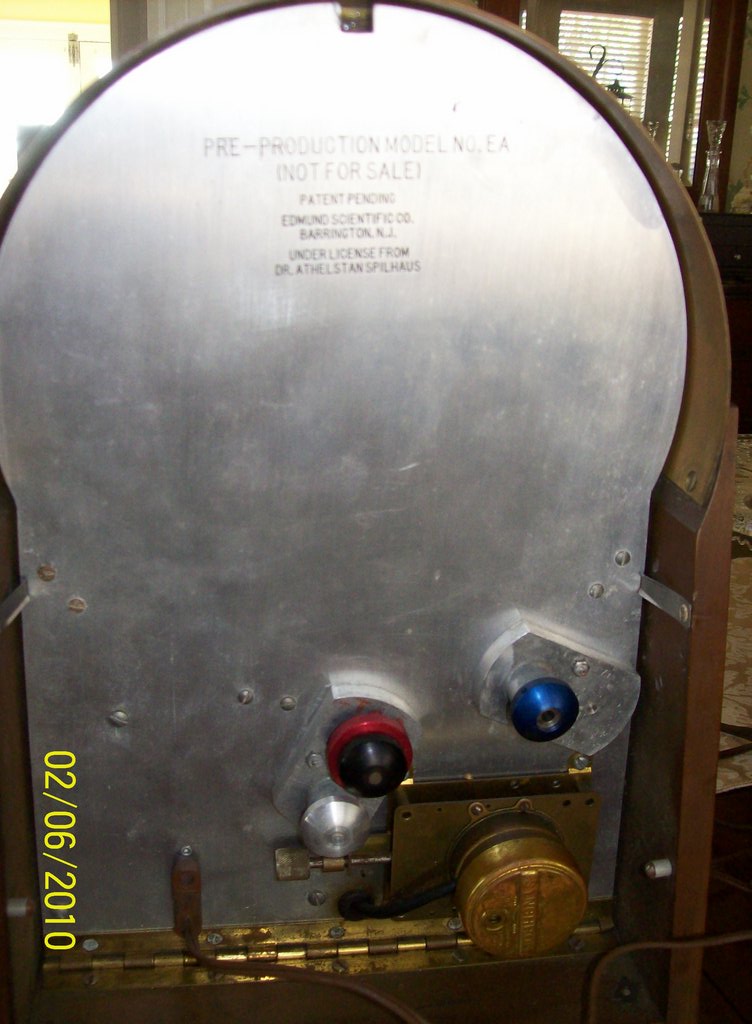
This clock came up for sale on ebay. The seller said that he bought it at a flea market in New Jersey with a lot of other scientific items. The clock was missing the star disk and the sun disk. As chance would have it, another prototype came up for sale on ebay a week after I bought the first one. The second had only the wood and brass clock housing and three disks, including the two missing ones I needed. The seller said that the person he bought it from literally had LOADS of Edmund stuff that seemed like it belonged to an employee or came from a storage facility. I bought the second clock and now I have a complete working prototype.The back panel reads "Pre- Production Model No. EA (Not For Sale) Patent Pending Edmund Scientific Co. Barrington, N.J. Under License From Dr. Athelstan Spilhaus". There are several differences between this clock and the production models, which will be discussed below.
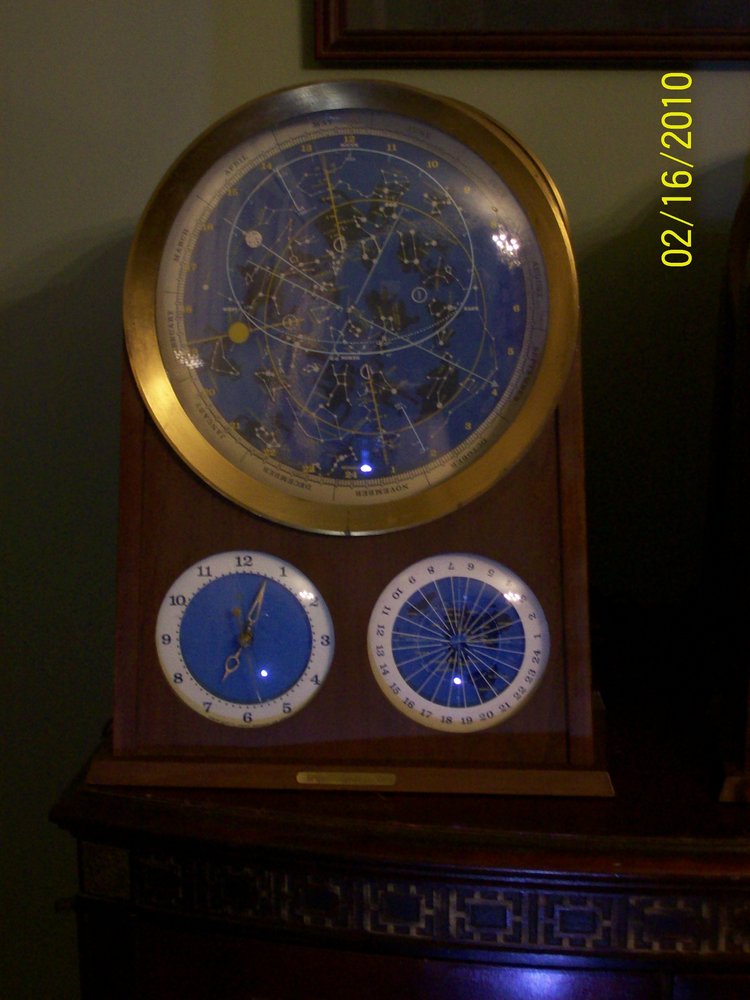
The first picture shows the front. The differences between this clock and production models are as follows: the clock borders with the numbers are white. On production models the left, or regular clock, has a gold border and the right, or 24 hour clock, has a gold and blue border. Also, the production 24 hour clock has the time lines for various world cities printed on the clock face, whereas the prototype has lines extending from the border towards the center (the border piece is a separate cover over the clock face). Furthermore, the continents on the prototype are dark blue on a light blue background, production clocks are gold on a light blue background. The production model is much easier to view and read.
The second picture shows the back. The prototype has an uncovered back with a hinge at the bottom (producton clocks had a wooden cover to hide the clock motor and controls). The prototype's aluminum back goes all the way to the top, the production clocks aluminum back does not extend up behind the large disks. By pressing the two tabs on either side, the back flips out and is held open at an angle by two stop pins. I wish the production clocks kept this idea - it is much easier to get inside one this way, but the light switch on production models would have had to be relocated. Notice that there is an adjustment knob missing - production models have five knobs, this one has four. The Sun Disk does not have an adjustment knob, it has to be lifted and set back in place in order to adjust it. Interesting side note: J.E. Coleman, author of The Best Of J.E. Coleman: Clockmaker, reviewed the Spilhaus Space Clock early in its production. He mentions the fact that the sun disk has to be lifted to be set. See the review here at the Sands Mechanical Museum website. This seems to have been changed by the addition of an adjustment knob either before production began or in early production. Also note in the picture below that the housings that the adjustment shafts go through are at different angles than on production clocks.
Disks Of The Space Dial - Prototype
Interestingly, the operator's manual for the Spilhaus Space Clock was not changed to reflect the final disk designs used in production. The disks of the prototype clock are shown in the black and white illustrations in the manual.
This picture shows the tide disk. The ink is a different color than production disks.

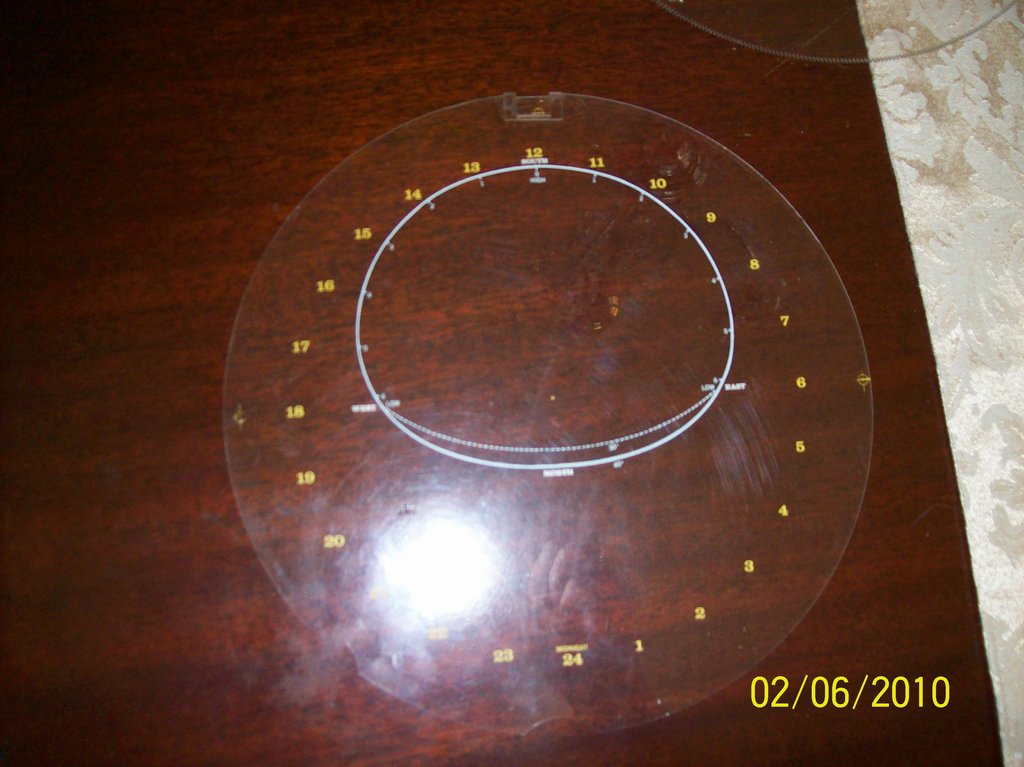
The second disk is the horizon disk. The horizon oval is a lighter ink color than on the production disks. It has two notches to fit around gears. The production model has one notch and it is in a different position. The production clocks have 15 minute time graduations in between the numbers of the 24 hour clock printed on the periphery of the disk, the prototype does not. The 15 minute time graduations make the production clocks a lot easier to set. Also, the centering "square" is at the top instead of the bottom.
The third disk is the moondisk. The moon image has craters and is painted onto the disk. Production models used a diffraction grating. The pointer line is lighter than on production clocks.
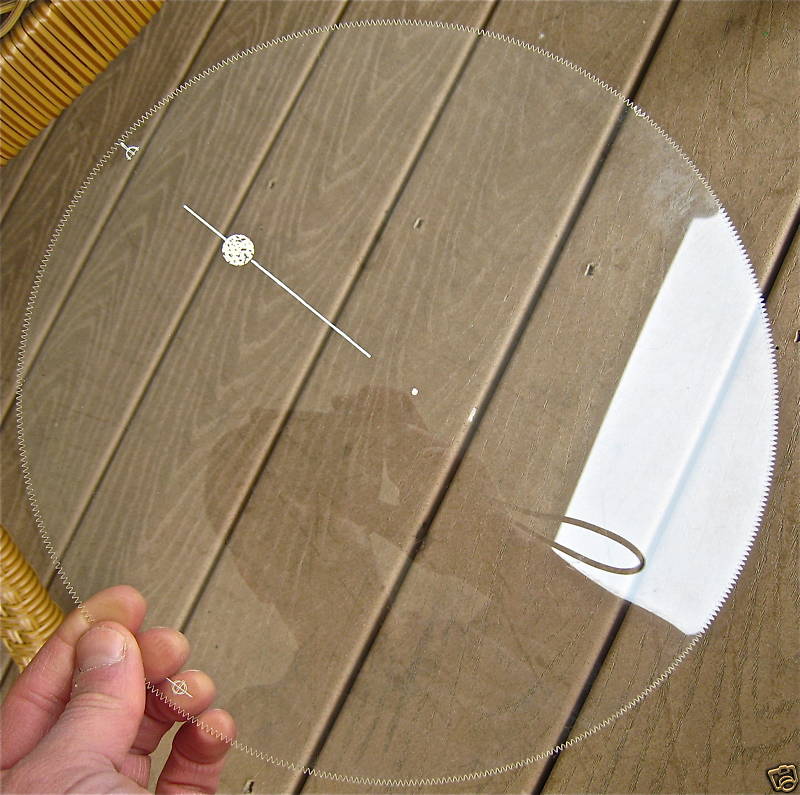
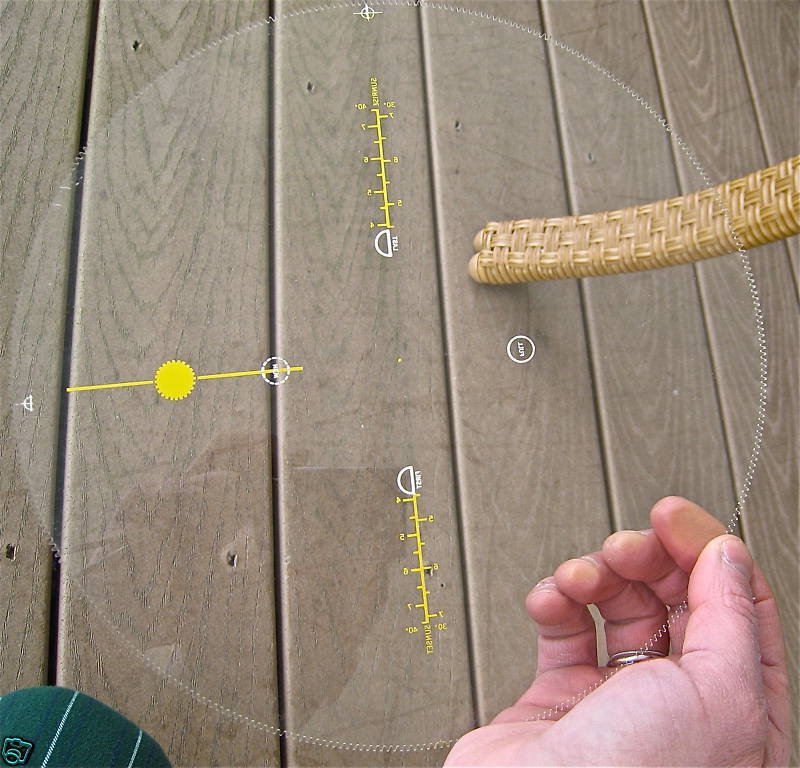
The fourth disk is the sun disk. The sun is painted onto the disk in yellow. Production models used a diffraction grating and the lines are gold.
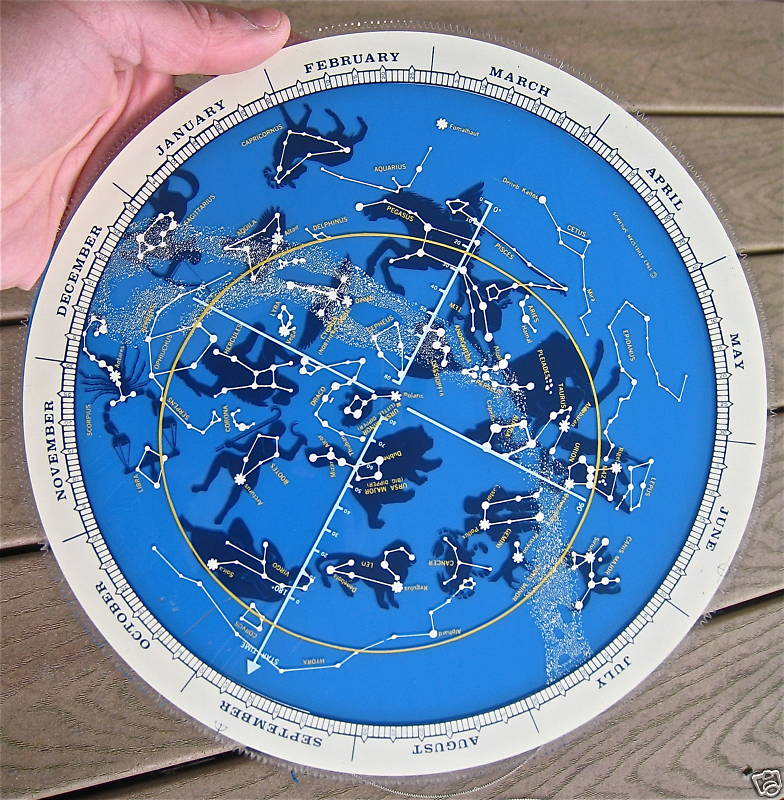
The fifth and final disk is the star and calendar disk. The main difference is the axis lines are positioned a few degrees differently than production models. Note that one axis line ends in an arrow that points to sidereal time. Production models have a separate arrow since the axis angle was moved slightly.
Updated June 18, 2011